Posted by RV Solutions on 27th Feb 2026
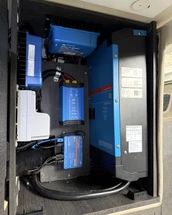
One of the most common questions we hear from RV owners planning a power upgrade is: when should I move to a higher battery voltage? The short answer is refreshingly simple — once your system starts drawing more than about 200 amps, it's usually time to step the voltage up. Past that point, everything downstream — cables, fuses, bus bars, breakers — starts getting bigger, heavier and more expensive.
The 200-amp figure isn't arbitrary — it's the practical ceiling for most affordable, readily-available DC components. Bus bars, disconnects, DC breakers and switches in the consumer market commonly top out around 250 amps. Push beyond that and you're into specialised, higher-cost territory, often with longer lead times.
To see why voltage matters so much, let's run the numbers on a real example: a 12V system with a 3,000W inverter. Because inverters are only about 90% efficient, the DC side has to supply more power than comes out the AC side. Add a standard 1.25× safety margin and it looks like this:
To carry 347 amps safely you're looking at a 350A fuse and 4/0 AWG cable (120mm²) — among the heaviest, priciest cable you can buy, and genuinely awkward to route through a motorhome or caravan.
Now run that same 3,000W inverter on a 24V system. The power is identical, but since current equals power divided by voltage, doubling the voltage halves the current:
At 174 amps the fuse drops to around 175A and the cable shrinks to roughly 2 AWG (35mm²) — a real saving in materials, and far easier to run through a build.
For the same power, doubling your battery voltage halves the current. Lower current means thinner cables, smaller fuses, cheaper protection components and less wasted heat throughout the whole system.
Using the same assumptions (90% efficiency, 1.25× margin), here's a practical guide to the inverter size that keeps a system comfortably around or below that 200-amp mark. These are real-world pairings we'd actually recommend and install — not hard electrical limits:
| Battery Voltage | Sensible Inverter Size | Best Suited To |
|---|---|---|
| 12V | Up to ~2,000W | Most caravans & smaller motorhomes |
| 24V | ~3,000–4,000W | Larger motorhomes & power-hungry setups |
| 48V | ~5,000W and up | High-demand, full-time & off-grid builds |
A quick reality check on the maths: at 12V a 2,000W inverter already pulls close to that 200-amp threshold, which is exactly why bigger inverters push you toward 24V or 48V. Go much past a 2,000W inverter on 12V and the cable and fuse costs climb steeply.
The benefit isn't just the inverter — your solar charge controller gets cheaper as well. With an 800W array, the charging current at different battery voltages works out roughly like this:
| Battery Bank | Approx. Charging Current (800W array) |
|---|---|
| 12V | ~67A |
| 24V | ~33A |
A controller rated for ~33A is noticeably cheaper than one rated for ~67A. Spread across a full build, those savings on multiple components add up to a meaningful difference.
High current doesn't just push up component costs — it wastes energy as heat. The heat generated in a circuit follows a simple formula:
Because the current is squared, doubling the current produces four times the heat loss — not twice as much.
Take a circuit with 0.5 milliohms of internal resistance (cables, fuses, bus bars, connections all added up):
| Current | Heat Generated |
|---|---|
| 200A | 20W |
| 400A | 80W |
That's 80W of continuous heat — four times as much — just from doubling the current. High-current systems are inherently less efficient and put far more thermal stress on every part in the circuit.
Higher voltage wins for most systems — but in mobile setups, particularly vans and motorhomes, two specific constraints can tip the balance the other way.
In a van or motorhome you usually charge from a 12V starter battery. Feeding a 48V house battery from that needs a specialised 12→48V DC-DC charger. They exist, but they're generally pricier and less common than the 12→12V or 12→24V options — so a 48V house bank can complicate your on-the-move charging.
A 48V battery can sit near 57.6V when fully charged, and your solar array needs to produce a few volts above that to charge it. In practice that often means panels wired in series — which isn't always practical on the limited roof of a caravan or motorhome.
For most motorhomes and caravans in New Zealand, 24V is the practical sweet spot. It delivers a real cut in current and component cost over 12V, without the added complexity and roof-space demands that a 48V system can bring. That said, for large, full-time or genuinely power-hungry off-grid builds — running induction cooking, air-conditioning and big inverters — 48V comes into its own. If that sounds like your setup, our guide to 48V RV power systems digs into that side in detail.
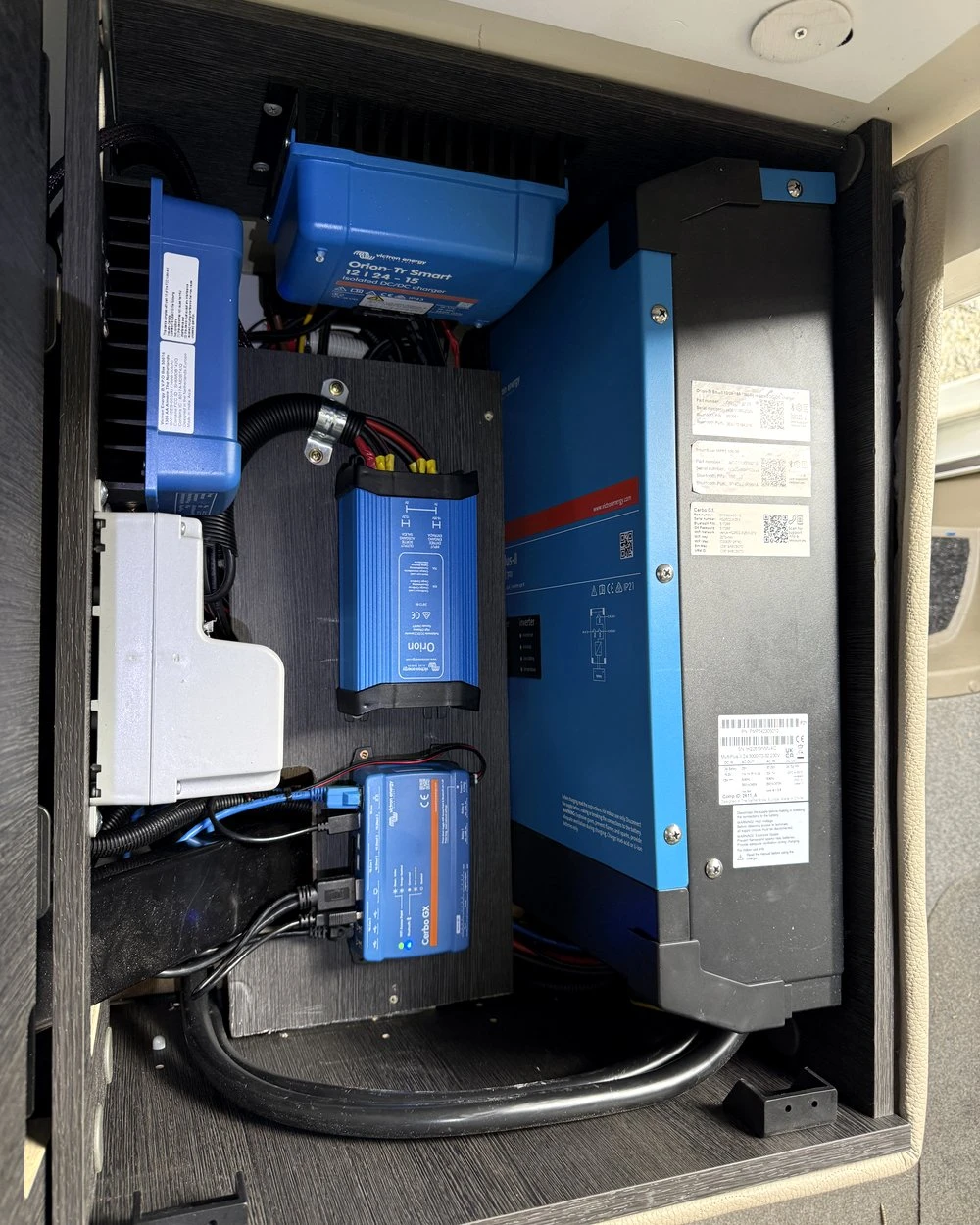
• Keep system current around or below 200A for affordable, off-the-shelf components
• 12V: sensible up to a ~2,000W inverter
• 24V: comfortable to ~3,000–4,000W
• 48V: for ~5,000W and serious off-grid demand
• For most vans and motorhomes, 24V is the best all-round balance
Getting the voltage right from the start keeps your cables, fuses, charge controller and bus bars in the affordable, widely-available range — and means less heat, less wasted energy, and a more reliable system overall. It's one of those decisions that's cheap to get right at the planning stage and expensive to change later.
Tell us your vehicle, your appliances and how you travel, and we'll help you choose the right system voltage and size every component to match — solar, batteries, inverter and charging, integrated properly. Honest advice, no obligation, from our Christchurch workshop.
Book a ConsultationThis article is general guidance to help you plan, not specific electrical advice for your vehicle. Real-world sizing depends on your exact loads, cable runs and components — always have system design and installation carried out by a qualified professional.
Posted by RV Solutions on 27th Feb 2026