Posted by RV Solutions on 23rd Aug 2026
If you're setting up a dual-battery or lithium system, a DC-DC charger is one of the most important parts — and three brands come up again and again: REDARC, Victron and Renogy. They're all good. But they're built for different priorities and price points. Here's an honest look at how they compare, so you can pick the right one for your rig.
Quick recap first: a DC-DC charger (or B2B charger) sits between your vehicle's alternator and your house battery, and charges that battery at the correct voltage and profile while you drive. If you're new to the idea, our guide to DC-DC chargers covers the what and why. This article is about which brand.
All three will charge your battery properly. The real differences come down to ruggedness, efficiency, features, ecosystem and price. As a rough guide:
you want the toughest, most feature-rich option for hard touring, and you value Australian-built durability and start-battery recovery over saving money.
you want the most efficient, refined unit, you're building a wider Victron system, or you like deep control and slick monitoring.
budget is the priority, your needs are modest, and you're happy to mount it somewhere well-ventilated.
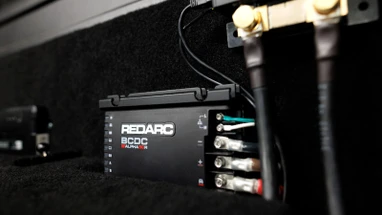
REDARC's BCDC range has powered off-grid touring for over a decade and sits at the premium end of the market. It's designed and built in Australia for harsh conditions, with IP67/69K dust and moisture protection, and it's the only DC-DC charger that can also recover a flat start battery — reviving it in as little as 15 minutes. Higher-end Alpha R models add app monitoring and a smart battery monitor. The trade-off is price: REDARC typically costs considerably more than Renogy, and more than Victron too.
Victron's Orion range — especially the newer Orion XS — is the most refined DC-DC option, with excellent efficiency (around 98% in independent testing) and complete control over charge settings. Its biggest strength is the Victron ecosystem: if you're running a Cerbo GX, a SmartShunt or other Victron gear, the Orion talks to all of it and displays live data alongside everything else through the VictronConnect app. The main catch is that most Orion models are DC-DC only, so you'll usually need a separate MPPT solar controller — adding cost and components.
Renogy's DC-DC chargers (like the DCC50S) are the value option — often a fraction of REDARC's price — and they include a built-in MPPT solar input and Bluetooth. For a weekend setup with modest needs, they do the job. The trade-offs show up under load: independent testing puts their efficiency lower (around 90–92%), and they run notably hotter — some units have been measured getting hot enough to de-rate their output — so they need to be mounted somewhere with good airflow.
| REDARC | Victron | Renogy | |
|---|---|---|---|
| Best for | Hard touring, durability | Efficiency, Victron systems | Budget, modest use |
| Efficiency | High | Highest (~98%) | Lower (~90–92%) |
| Ruggedness | Excellent (IP67/69K) | Very good | Good (needs airflow) |
| Built-in solar MPPT | Yes | Usually no (separate) | Yes |
| Start-battery recovery | Yes (unique) | No | No |
| Ecosystem / app | REDARC RedVision | VictronConnect (deep) | Renogy app |
| Relative price | $$$ | $$ | $ |
General guidance at the time of writing — exact specs, models and prices change, so check current figures before buying.
There's no single "best" — it genuinely depends on how you travel and what you value:
REDARC. The ruggedness, alternator protection and start-battery recovery earn their keep when you're a long way from help.
Victron Orion. Superb efficiency and unbeatable integration if the rest of your system is Victron.
Renogy. Does the job for modest needs at a fraction of the price — just give it good airflow.
Whichever charger you choose, it's only as good as how it's installed. Correct sizing, cable and fuse ratings, mounting location, solar integration and charge settings make the difference between a system that performs for years and one that disappoints from day one. That's the bit we take care of — whatever brand you land on.
Tell us your vehicle, your battery and how you travel, and we'll recommend and install the right DC-DC charger — REDARC, Victron or otherwise. Honest advice, no obligation, from our Christchurch workshop.
Talk to UsThis article is general information to help you compare options, not specific advice for your vehicle. Brand specifications, models and prices change over time and vary by supplier — always confirm current details, and have DC-DC and battery work designed and installed by a qualified professional.
Posted by RV Solutions on 23rd Aug 2026