
RV Solutions

  • Sign in or Register
  • ()
close
  • Sign in or Register
  • Online Shop
    • Electrical
    • Solar
    • Battery Chargers-Accessories
    • Motorhome Batteries
    • Reversing Camera
    • Inverters for Motorhomes
    • Generators
    • Entertainment
    • Plumbing
    • Tanks
    • Toilets
    • Pumps
    • Appliances
    • Refrigeration
    • Washing Machine
    • Cooking
    • Accessories
    • Heating/cooling
    • Air Conditioner
    • Space Heaters for RVs
    • Water Heaters
    • Victron Products
    • Victron Solar Controllers
    • Victron Inverters
    • Victron Battery Chargers
    • Victron Converters and Power Supplies
    • Victron Battery Monitors and Protection
    • External
    • Hardware
    • Awnings, Covers
    • Motor Movers
    • Vents, Fans
    • Bike Racks
    • Levellers and Jacks
  • Our Services
    • RV Electrical
    • RV and Caravan Solar Installations
    • RV Inverter Installation
    • RV Battery Upgrades
    • RV Electrical Testing and Certification
    • RV Plumbing & Water Systems
    • RV & Caravan Water Tank Installation
    • RV Hardware Installation
    • RV Heater Installation
    • RV Satellite Installation
    • Motor Movers for Caravans
    • RV Reversing Cameras & Security Systems
    • RV Bike Rack Installation
  • RV Self-Containment Certification
  • RV Solar Calculator
  • About RV Solutions
  • Contact Us
    • Parts Enquiry
    • Workshop Enquiry
  • Shipping & Returns
    • Thank you – RV Solar Calculator
  • Blog

Specialists in RV Solar, Electrical Systems & Power Solutions

Email Us

✉️ info@rvsolutions.co.nz

64 Sandyford Street Christchurch

Complete Motorhome Solar System Guide | RV Solutions Christchurch
Back to Solar Installation Solar Guide

Complete Motorhome Solar System Guide

Published by RV Solutions Christchurch

Everything you need to know about designing, sizing, and installing a solar power system for your motorhome or caravan in New Zealand.

Solar power has revolutionized freedom camping in New Zealand, allowing motorhome and caravan owners to explore remote locations without worrying about power. This comprehensive guide covers everything from system design to installation, helping you make informed decisions about your RV solar setup.

Why Solar Power for Motorhomes?

A properly designed solar system provides several key benefits for motorhome and caravan owners:

  • Extended off-grid capability: Stay at freedom camping spots for days or weeks without running a generator or needing mains power hookup
  • Silent operation: Unlike generators, solar panels produce power silently, respecting both you and your neighbors
  • Environmental benefits: Renewable energy with zero emissions, perfect for enjoying NZ's pristine natural environment
  • Cost savings: Once installed, solar power is free—no ongoing fuel costs or campground fees for powered sites
  • Battery health: Keeps batteries properly charged, extending their lifespan significantly
  • Modern conveniences: Run fridges, lights, water pumps, laptops, and entertainment systems without compromise

New Zealand Conditions

New Zealand's variable weather means solar system sizing is critical. Winter solar generation can be 50-70% less than summer, and our long, narrow country means different regions receive different sun hours. A system designed for summer use in Northland may struggle in winter in Otago.

Understanding Solar System Components

1. Solar Panels

Solar panels are the visible face of your system, mounted on your RV roof to capture sunlight and convert it to electrical energy. Modern panels are remarkably efficient and durable.

Panel Types:

Panel Type Efficiency Best For Cost
Monocrystalline 18-24% Limited roof space, maximum power $$$ - Best performance/watt
Polycrystalline 15-17% Budget-conscious, larger roof area $$ - Good value
Flexible Panels 15-18% Curved roofs, lightweight requirement $$$ - Convenience premium

Monocrystalline panels are the gold standard for motorhomes. They're more efficient, meaning you get more power from less roof space—critical when every square meter counts. They also perform better in low light and high temperatures, common conditions in NZ.

Flexible panels are tempting due to their sleek appearance and easy installation, but be aware they typically have shorter lifespans (5-10 years vs 20-25 years for rigid panels) and can overheat when mounted flush to the roof, reducing output.

Installation Tip

Always mount rigid panels with at least 20mm clearance underneath for airflow. This prevents overheating and can increase power output by 10-15%. Use proper mounting brackets—never glue panels directly to your roof.

2. Charge Controllers

The charge controller is the brain of your solar system, regulating power flow from panels to batteries and preventing overcharging or damage.

MPPT vs PWM Controllers:

  • MPPT (Maximum Power Point Tracking): 20-30% more efficient than PWM, especially in cooler weather or partial shade. Worth the investment for systems over 200W. Essential for lithium battery systems.
  • PWM (Pulse Width Modulation): Simpler, cheaper technology. Adequate for small systems (under 200W) with AGM batteries in warm climates.

For New Zealand conditions, MPPT controllers are strongly recommended. The efficiency gains pay for the cost difference within 1-2 years, and they're essential for extracting maximum power during our shorter winter days.

3. Batteries

Your battery bank stores the energy collected by solar panels for use when the sun isn't shining. This is often the most expensive component and deserves careful consideration.

Battery Technology Comparison:

Battery Type Lifespan Usable Capacity Weight (100Ah) Cost
AGM 3-5 years 50% (use only half) 28-32 kg $$ - Lower upfront
Lithium (LiFePO4) 10-15 years 90-100% 12-14 kg $$$$ - Higher upfront, lower lifetime cost

AGM batteries are proven technology, widely available, and more affordable upfront. However, you can only safely use about 50% of their capacity before damaging them. A 200Ah AGM bank provides roughly 100Ah of usable power.

Lithium batteries represent a significant upfront investment but offer compelling advantages:

  • 90-100% of capacity is usable (200Ah lithium = 180-200Ah usable)
  • Charge 4-5 times faster than AGM
  • 60% lighter—crucial for payload-limited motorhomes
  • Last 3-4 times longer than AGM
  • Maintain voltage under load better (appliances run more efficiently)

⚠️ Important: Lithium Battery Considerations

Not all lithium batteries are created equal. Ensure yours has a quality BMS (Battery Management System) with low-temperature charging cutoff—lithium batteries can be permanently damaged if charged below 0°C. This is critical for NZ conditions where morning temperatures can drop below freezing.

4. Inverters

An inverter converts your 12V DC battery power to 240V AC, allowing you to run standard household appliances. See our detailed technical guide to RV inverters for more information.

Key considerations:

  • Pure sine wave: Essential for sensitive electronics like laptops, medical equipment, and modern appliances
  • Sizing: Match to your largest appliance's running watts plus 20-30% surge capacity
  • Efficiency: Look for 90%+ efficiency at typical load levels

Sizing Your Solar System

Proper system sizing is critical—too small and you'll constantly run low on power; too large and you've wasted money on capacity you'll never use.

Step 1: Calculate Your Daily Power Consumption

List every electrical device you'll use and estimate daily consumption:

Appliance Power Draw Hours/Day Daily Consumption
12V Compressor Fridge 45W (average) 24 hours 90Ah (cycling)
LED Lights (4x) 24W total 4 hours 8Ah
Water Pump 36W 0.5 hours 1.5Ah
Laptop (via inverter) 60W (72W with losses) 3 hours 18Ah
Phone Charging (2x) 10W 2 hours 1.7Ah
Total Daily Consumption: ~120Ah

Power Calculation Formula

For 12V systems: (Watts ÷ 12V) × Hours Used = Amp-hours (Ah)
For 240V through inverter: Add 15-20% to account for inverter losses

Step 2: Size Your Battery Bank

Your battery bank should provide at least 2-3 days of power without solar input (for cloudy weather):

  • With AGM batteries: Daily consumption × 3 days × 2 (50% usable) = Battery capacity needed
  • Example: 120Ah daily × 3 days × 2 = 720Ah of AGM batteries
  • With lithium batteries: Daily consumption × 3 days = Battery capacity needed
  • Example: 120Ah daily × 3 days = 360Ah of lithium batteries

Step 3: Size Your Solar Array

Your solar panels need to replenish daily power use plus charge losses (typically 20-30%):

  • Summer (5-6 effective sun hours): 120Ah daily ÷ 5 hours = 24A charging × 12V = ~300W panels
  • Winter (2-3 effective sun hours): 120Ah daily ÷ 3 hours = 40A charging × 12V = ~480W panels

Recommended approach for NZ: Size your system for winter conditions if you plan year-round use, or accept that you'll need to supplement charging (driving, generator, mains hookup) during winter months.

Real-World Example: Standard Motorhome Setup

Daily consumption: 120Ah
Battery bank: 300Ah lithium (or 600Ah AGM)
Solar array: 400-600W (for year-round use)
Charge controller: 30-40A MPPT
Inverter: 2000W pure sine wave

This setup provides reliable off-grid power year-round in most NZ locations with typical usage patterns.

Installation Considerations

Roof Layout

Effective roof layout maximizes solar collection while avoiding shading from roof-mounted equipment:

  • Panel orientation: North-facing panels (in Southern Hemisphere) collect most energy, but roof space usually dictates orientation
  • Shading: Even small shadows can significantly reduce output. Keep panels clear of air conditioners, satellite dishes, vents, and antennas
  • Tilt: Flat mounting is simplest and most aerodynamic. Tilting panels 15-30° increases winter output but adds complexity and wind resistance
  • Access: Leave space for roof access, maintenance, and future additions

Wiring and Safety

Proper wiring is critical for safety and efficiency:

  • Cable sizing: Undersized cables waste power and create fire hazards. Use at least 6mm² for panel to controller runs over 2m
  • MC4 connectors: Industry-standard waterproof connections for solar panels
  • Circuit protection: Fuses or circuit breakers on both positive and negative lines
  • Cable routing: Protect cables from chafing, UV exposure, and heat. Use conduit where possible

⚠️ Safety Warning

Solar system installation involves working on RV roofs, high voltages, and permanent electrical modifications. If you're not confident in your abilities, professional installation is strongly recommended. Incorrect installation can result in fire, electrical shock, or damage to your RV's electrical system.

Monitoring Your System

A good battery monitor is essential for understanding your system's performance:

  • Voltage monitoring: Shows battery state but isn't accurate under load
  • Amp-hour counting: Tracks power in/out like a fuel gauge—much more accurate
  • Victron SmartShunt: Bluetooth-connected monitoring with excellent app support
  • Built-in displays: Many modern charge controllers include comprehensive monitoring

Maintenance and Troubleshooting

Regular Maintenance

  • Panel cleaning: Dirty panels can lose 20-30% efficiency. Clean with water and soft cloth every 2-3 months
  • Connection checks: Tighten all terminals annually. Loose connections create resistance and heat
  • Battery maintenance: AGM batteries benefit from occasional equalization charges. Lithium batteries need cell balancing (usually automatic)
  • Shade assessment: Check for new shade sources as trees grow or equipment is added

Common Issues

Low charging current:

  • Check for shading on panels (even partial shade dramatically reduces output)
  • Verify all connections are tight and corrosion-free
  • Confirm charge controller settings match your battery type
  • Test panel output with multimeter

Batteries not holding charge:

  • AGM batteries sulfate if left discharged—may be permanently damaged
  • Check for parasitic loads draining batteries when parked
  • Verify charge controller is reaching full charge voltage
  • Battery capacity naturally decreases with age

Costs and Return on Investment

Solar system costs vary widely based on size and component quality:

  • Basic system (200W, AGM batteries): $2,000-$3,000
  • Mid-range system (400W, lithium batteries): $4,000-$6,000
  • Premium system (600W+, lithium, inverter): $7,000-$12,000+

ROI calculation: If you freedom camp 100 nights per year instead of using powered sites ($30-50/night), a $6,000 system pays for itself in 2-4 years, then provides free power for its 20+ year lifespan.

Ready to Install Solar on Your Motorhome?

RV Solutions in Christchurch provides professional solar system design and installation. We'll calculate your power requirements, recommend the right components, and install everything to the highest standards.

Book Solar Installation Learn More

Conclusion

A well-designed solar system transforms motorhome and caravan travel, providing reliable off-grid power and genuine freedom to explore New Zealand's incredible landscapes. While the upfront investment is significant, the long-term benefits—both financial and lifestyle—make solar power one of the best upgrades you can make to your RV.

The key to success is proper system sizing based on realistic power consumption calculations. Oversizing slightly provides margin for cloudy days and future electrical additions, while undersizing leads to constant compromise and battery damage.

For New Zealand conditions, we recommend:

  • Monocrystalline panels for maximum efficiency
  • MPPT charge controllers for optimal winter performance
  • Lithium batteries if budget allows (significantly better performance and lifespan)
  • 400-600W minimum for year-round full-time use
  • Professional installation for safety and optimal performance

Whether you're a weekend warrior or full-time traveler, solar power opens up New Zealand's most beautiful freedom camping locations without the noise, fumes, or expense of generators.

Related Resources

Solar Installation Service RV Inverter Technical Guide RV Battery Upgrades RV Electrical Services Book Workshop Enquiry Contact Us
  1. Home
  2. Blog
  3. Complete Motorhome Solar System Guide
Complete Motorhome Solar System Guide

Posted by RV Solutions on 22nd Jan 2026
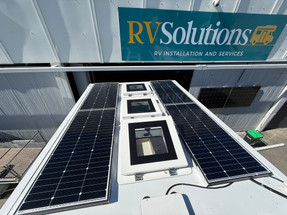
Complete Motorhome Solar System Guide

  • Facebook
  • Email
  • Print
  • Twitter
  • Pinterest
Newsletter Signup

Footer Start

Categories
  • Online Shop
Information
  • Our Services
  • RV Self-Containment Certification
  • RV Solar Calculator
  • About RV Solutions
  • Contact Us
  • Shipping & Returns
  • Blog
  • Sitemap
Follow Us
RV Solutions
64 Sandyford Street
Sydenham
Christchurch
8023

© 2026 RV Solutions

Powered by BigCommerce

Theme by Weizen Young